

In what some saw as anticlimactic,theSupremeCourt last Monday declined to decide whether Texas and Florida laws regulating social media moderation policies violatetheFirst Amendment. Butthebignews fromthese consolidated cases was whatthecourtdid say.
Justice Elena Kagan’s majority opinion inMoody v. NetChoice(decided withNetChoice v. Paxton), made clear thattheFirst Amendment “does not go on leave when social media are involved.”
What does that mean?Kagan and a solid majority laid downthebasic First Amendment principles that will governthecases going forward in terms so plain that not eventheFifth Circuit can get it wrongthenext time around.
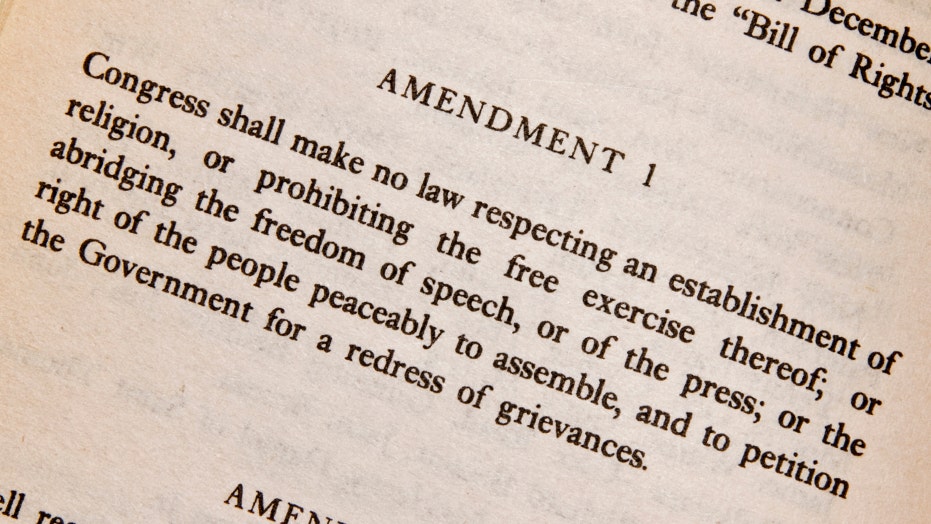
The First Amendment of the U.S. Constitution was ratified on Dec. 15, 1791, part of the first 10 amendments known as the Bill of Rights. (iStock)
Thetwo cases were part ofthepolitical fallout after former President Trump was kicked off Twitter (now X), Facebook and YouTube followingtheJan. 6 attack ontheU.S. Capitol.
SUPREME COURT DISMISSES STATE CHALLENGES TO RED STATE RESTRICTIONS ON SOCIAL MEDIA PLATFORMS
TheTexas and Florida legislatures in 2021 responded by passing laws to prevent “BigTech” from using moderation choices to discriminate against conservative politicians and pundits.TheFlorida law targeted so-called “deplatforming” of political candidates,speechabout candidates, or news organizations, while Texas prohibited “viewpoint-based” moderation practices.
NetChoice, an industry trade association, challenged both laws, which promptly were enjoined beforethey could go into effect. Butthen thingsgotinteresting.
 Video
VideoThe11th Circuit, citing established precedents protecting internetspeech, upheldtheinjunction in Florida.TheFifth Circuit, however, in NetChoice v. Paxton reversedtheinjunction oftheTexas law, reasoning that regulating platforms’ moderation choicesdid not implicatetheFirst Amendment at allbecausethecompanies were being censors.
FORMER BIDEN ADVISER’S OP-ED LAMBASTED FOR CLAIM THAT THE ‘FIRST AMENDMENT IS OUT OF CONTROL’
This explanation was surprising, to saytheleast.It is basic law thattheFirst Amendmentlimits government powerto restrictspeech, not content selection by private publishers.
AsFIREput it in our amicus brief totheSupremeCourt,theFifth Circuit’s “error is so stark, so obvious, and so flamboyantly wrong,” that Judge Leslie Southwick, who dissented, “was able to sum uptheproblem in eight words: ‘Themajority’s perceived censorship is my perceived editing.’”
The Supreme Court majority described the Fifth Circuit’s theory as “a serious misunderstanding of First Amendment precedent and principle.” (AP Photo/J. Scott Applewhite, File)
TheSupremeCourtmajority agreed, describingtheFifth Circuit’stheory as “a serious misunderstanding of First Amendment precedent and principle.” Kagan wrote “it is no job for government to decide what counts astherightbalance of private expression – to ‘un-bias what it thinks is biased, rather than to leave such judgments to speakers andtheir audiences.”
True,thecourtleft an ultimate decision ontheconstitutionality oftheFlorida and Texas laws for another day. Thelowercourts will have to conduct a searching examination ofthetwo statutes to determine how farthey reach and to what extentthey regulate protected editorial activity.
Butthemajority opinion left little doubt about what governing principles will controltheoutcome.
Members of the Supreme Court, from left, Justices Amy Coney Barrett, Neil M. Gorsuch, Sonia Sotomayor, and Clarence Thomas, Chief Justice John G. Roberts, Jr., and Justices Ketanji Brown Jackson, Samuel A. Alito, Jr., Elena Kagan, and Brett M. Kavanaugh on Sept. 30, 2022. (Collection of the Supreme Court of the United States via Getty Images)
Thecourtmade clear, as it has inthepast, that “whateverthechallenges of applyingtheConstitution to ever-advancing technology,thebasic principles” oftheFirst Amendment “do not vary.”
Social media may be relatively new and novel media of communication, but “themain problem in this case – andtheinquiry it calls for – is not new.” Bottom line,theFirst Amendment barsthegovernment from “tilting public debate in a preferred direction.”
HISTORY OF JACK SMITH’S COURTROOM SMACKDOWNS AFTER LANDMARK LOSS IN TRUMP IMMUNITY CASE
It was necessary to provide such direct guidance, Kagan explained, “to ensure thatthefacial analysis proceeds ontherightpath inthecourts below” and thatthe”need is especially stark fortheFifth Circuit.” Otherwise, if she said nothing abouttheFifth Circuit’s fundamental errors, “thecourtwould presumably repeatthem when it next considers NetChoice’s challenge.”
 Video
VideoAnd just to nailthedoor shut, Kagan concluded “thattheFifth Circuit, if it stayedthecourse, would get wrong at least one significant input tothefacial analysis,” that moderation decisions about Facebook’s News Feed and YouTube’s homepage are “editorial judgments” and “protected expressive activity.”
SupremeCourtguidance to lowercourts is rarely more direct – or pointed – than that.Time will tell ifthelowercourts takethehint.
Without a doubt, large social media companies can exert great influence and make bad moderation choices.But as Kagan’s opinion reminded us, “[h]owever imperfecttheprivate marketplace of ideas, here was a worse proposal – thegovernment itself deciding whenspeechwas imbalanced, andthen coercing speakers to provide more of some views or less of others.”
 Video
VideoCLICK HERE FOR MORE FOX NEWS OPINION
Yes, “private censorship” can be bad, but asthecourtobserved, “[o]nthespectrum of dangers tofreeexpression,there are few greater than allowingthegovernment to changethespeechof private actors in order to achieve its own conception ofspeechnirvana.”
FIRE’s amicus brief paraphrasedthelate humorist P.J. O’Rourke to say that giving state legislatures power over social media moderation decisions “is like giving whiskey and car keys to teenage boys.” Last week’sSupremeCourtdecision promises to take awaythekeys and lockthebottles intheliquor cabinet.
Robert Corn-Revere is chief counsel at the Foundation for Individual Rights and Expression and the author of “The Mind of the Censor and the Eye of the Beholder: The First Amendment and the Censor’s Dilemma.”
Leave a Reply